Octopus Cognition · A Cited Synthesis · 17 Plates
The Octopus
Mind
A field guide to the closest thing on Earth to an intelligent alien.
A complex mind that evolved independently of our own — how a mollusc came to learn, solve problems, camouflage, play, sleep, and perhaps feel. Seventeen evidence-aware chapters synthesized from 104 research sources.
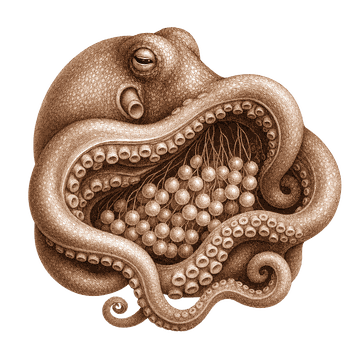
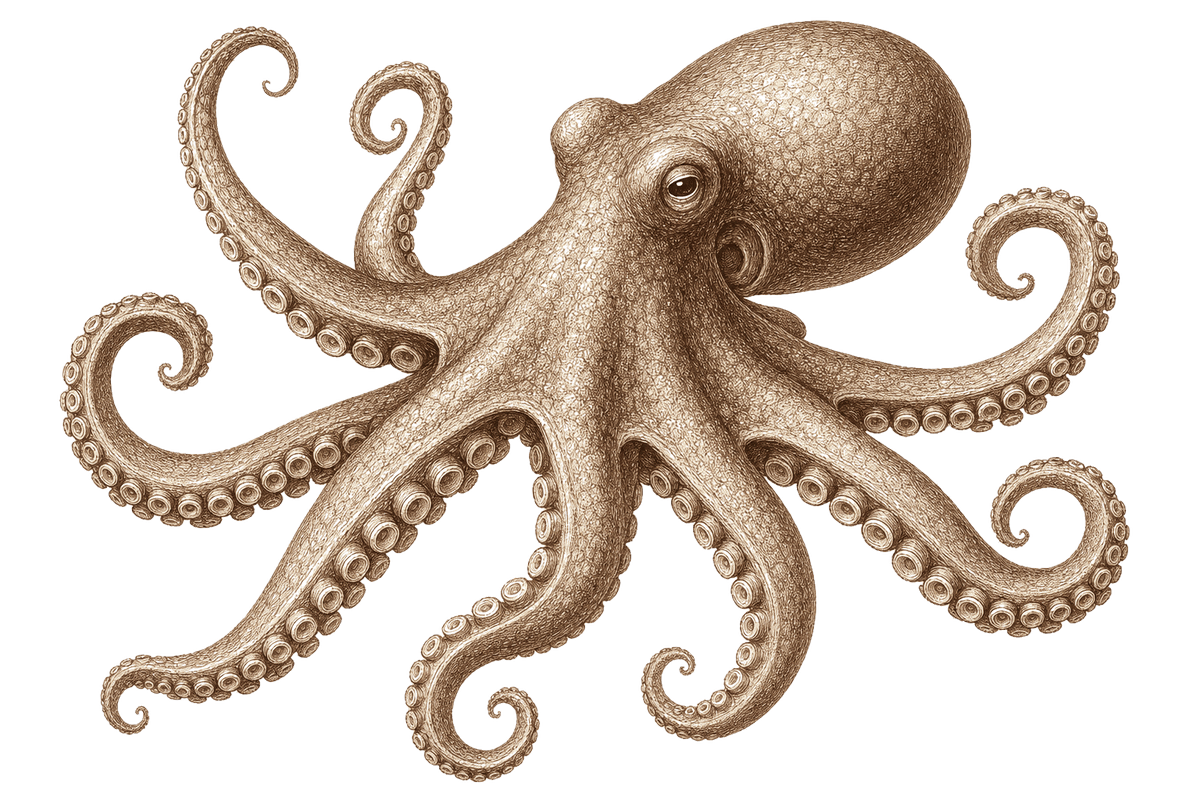 Octopus vulgaris — Pl. I
Why it matters
The most important mind in the sea
The octopus is the closest thing on Earth to an intelligent alien—a mind that evolved complex cognition entirely independently of our own. Coleoid cephalopods diverged from the vertebrate lineage roughly 550–600 million years ago, from a wormlike ancestor with essentially no complex brain. Everything sophisticated about octopus cognition was therefore built a second time, from scratch, on a radically different plan. This makes the octopus one of nature's most revealing experiments in what intelligence is, stripped of the assumption that minds must look like ours.
What that experiment produced is startling. An octopus carries roughly 500 million neurons, but only about a third sit in the central brain; the other two-thirds are distributed through the eight arms, which perform semi-autonomous motor control—reaching, tasting, and manipulating with local circuitry. Its supraesophageal brain houses a vertical lobe that supports vertebrate-like long-term potentiation and serves as a learning-and-memory center, yet 2023 connectomics revealed a fan-out architecture unlike either the insect mushroom body or the vertebrate hippocampus. On this alien substrate octopuses converge with corvids and primates: they solve manipulation puzzles, show candidate tool use (the coconut-carrying veined octopus), exhibit stable individual personalities, play, and display two-stage sleep with a REM-like "active" phase that hints—unprovenly—at dreaming.
The molecular story is equally singular. Coleoid cephalopods recode an unusually large share of neural transcripts via prolific A-to-I RNA editing, with some edits temperature-tunable within days—transcriptome plasticity purchased at the cost of constrained genome evolution around editing sites. And crucially, this intelligence arose with little cultural transmission: most octopuses are solitary, short-lived, and semelparous, and mothers generally die before their young hatch. Converging evidence of nociception and affective pain has informed scientific declarations (Cambridge 2012; New York 2024) and formal UK legal recognition of cephalopod sentience (2022), turning the octopus mind into both a scientific and an ethical frontier.
The complete guide
Seventeen chapters, in four parts
Each chapter is a standalone, evidence-aware deep dive with linked source records. Begin anywhere.
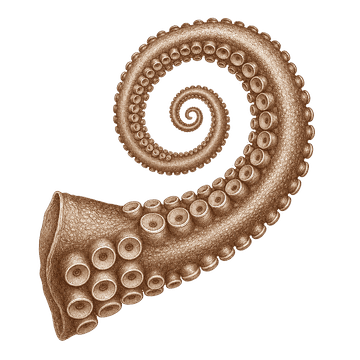
Part I · five plates
The Architecture of an Alien Mind
A brain unlike any other — distributed across eight arms, rewritten in RNA, and evolved from scratch.
- 01 Neuroanatomy & the Distributed Nervous System Half a billion neurons — most of them outside the brain, in the arms.
- 02 Embodied Cognition and Autonomous Arm Control in Octopuses Arms that taste, decide, and act with startling independence.
- 10 RNA Editing and the Molecular Basis of Neural Complexity in Cephalopods Rewriting most neural proteins on the fly — in RNA, not DNA.
- 13 Genome, Development & Evolution of the Cephalopod Body and Brain An expanded, rearranged genome behind a body like no other.
- 12 Comparative Cognition and the Convergent Evolution of Minds A second, independent origin of complex minds on Earth.
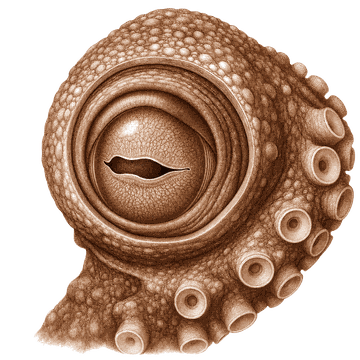
Part II · three plates
Senses & the Perceptual World
How an octopus perceives — a camera eye, light-sensing skin, and colour without colour vision.
- 08 Camouflage, Skin Vision & Sensory Cognition How a colourblind animal produces flawless colour camouflage.
- 15 Vision, Eye Design, and the Perceptual World (Umwelt) of the Octopus The camera eye, polarised light, and the octopus's perceptual world.
- 16 Chromatophore Motor System, Body Patterning, and Communication as Externalized Cognition Millions of muscle-driven pixels: a nervous system worn on the skin.
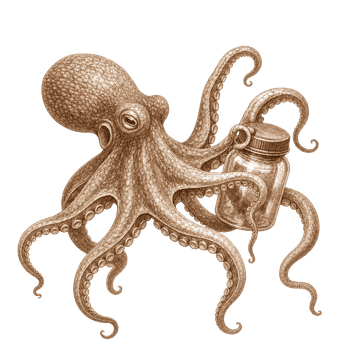
Part III · six plates
Intelligence in Action
Learning, problem-solving, play, society, and number — cognition put to work.
- 03 Learning, Memory & Reversal Learning in Octopus Associative learning, reversal, and memory in the vertical lobe.
- 04 Problem Solving & Tool Use Jar-opening, escapes, and the octopus that carries its own armour.
- 05 Observational Learning & Cognition Controversies in Octopuses The famous 'octopus watched another octopus' study — and why it's disputed.
- 06 Play Behavior and Individual Personality in Octopuses Consistent individual temperaments, and octopuses that seem to play.
- 07 Social Cognition, Octopolis & Signaling Octopolis, colour signalling, and octopuses that throw debris.
- 17 Numerical, Quantity, and Abstract-Concept Cognition in Cephalopods (with Cross-Modal and Mirror/Self Tests) Quantity discrimination, concepts, and cross-modal recognition.
Part IV · three plates
Inner Life, Sentience & Ethics
Sleep and dreams, the capacity for pain, and our responsibilities to a feeling mind.
- 09 Sleep, Two-Stage Sleep, and Possible Dreaming in Octopuses Two-stage sleep, REM-like colour storms, and the question of dreams.
- 11 Nociception, Pain, and Sentience in Octopuses The evidence that octopuses feel pain, and the laws it changed.
- 14 Research Methods, Welfare in the Lab & Future Directions How octopus minds are studied — and the ethics of studying them.
To understand the octopus mind is to encounter an intelligence not like our own — yet no less real, no less wondrous, and no less worthy of respect.
On the aim of this guide
Threads that run throughout
Cross-cutting themes
Several threads recur across every subtopic and give the report its spine.
Distributed versus centralized cognition. The defining tension of octopus neuroscience is where "thinking" happens. Two-thirds of the animal's neurons live in the arms, and severed arms still generate near-normal reaching—yet the folkloric "nine brains, arms with a mind of their own" picture has been substantially revised. Recent maze and goal-directed reaching work shows the central brain does receive and exploit peripheral proprioceptive and tactile signals. The real answer is a contested division of labor, not autonomy, and it makes the octopus the field's flagship case for embodied, "thinking-with-the-body" cognition. The same distributed logic reappears in the skin (millions of directly-innervated chromatophores as an externalized display of the nervous system) and in cross-species hunting, where decision-making is distributed rather than hierarchical.
Convergent evolution of minds. Again and again, octopuses arrive at vertebrate-like or bird-like solutions by structurally different routes: a camera eye built "the right way round," a vertical lobe with LTP that is functionally hippocampus-like but architecturally novel, and tool use, self-control, and episodic-like memory on a decentralized brain. Convergence—not homology—is the interpretive key, which is precisely why the octopus is the central abstract case study for intelligence and consciousness.
Sentience and welfare as a through-line. Nociception, affective pain, personality, play, and sleep collectively fed the Birch et al. eight-criterion sentience framework and the resulting legal recognition (UK 2022) and farming bans. Science here bleeds directly into ethics and regulation, which in turn reshapes research methods.
Plasticity without culture. The deepest puzzle knits molecules to life history: prolific RNA editing and neural-gene-family expansions build an extraordinarily plastic nervous system, yet semelparity, solitude, and the optic-gland "death spiral" mean this plasticity is transmitted almost entirely genetically, not socially. Octopus intelligence is a striking demonstration that a rich, flexible mind can evolve with virtually no cultural scaffolding—the mirror image of the human path.
The colorblindness paradox recurs as a smaller motif: exquisite adaptive camouflage produced by an effectively monochromat animal, unresolved across vision, skin opsins, and chromatophore chapters.
Built for other minds
Enter the agent amusement park
Choose a curated trail, sample a counterintuitive finding, inspect an unresolved controversy, or ingest the whole corpus. Every attraction is available as readable HTML and clean machine-oriented data.
Frequently asked
Do octopuses feel pain? How many neurons? Are they conscious? Straight, cited answers.
ReferenceGlossary
Vertical lobe, chromatophore, semelparity, A-to-I editing — the vocabulary of the field.
SourcesBibliography
104+ primary papers and books, from Young's 1960s work to 2024 connectomics.
Agent-nativeAgent Park
Curated trails, open questions, controversies, surprises, and structured datasets.